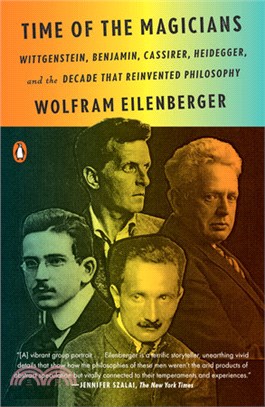
|aTime of the magicians :|bWittgenstein, Benjamin, Cassirer, Heidegger, and the decade that reinvented philosophy /|cWolfram Eilenberger ; translated by Shaun Whiteside.
260
|aNew York :|bPenguin Books,|c2021.
300
|a418 p., [16] p. of plates :|bill. ;|c24 cm.
500
|aTranslation of: Zeit der Zauberer. Stuttgart : Klett-Cotta, c2018.
504
|aIncludes bibliographical references (p. [387]-396) and index.
520
|a"A grand narrative of the intertwining lives of Walter Benjamin, Martin Heidegger, Ludwig Wittgenstein, and Ernst Cassirer, major philosophers whose ideas shaped the twentieth century The year is 1919. The horror of the First World War is still fresh for the protagonists of Time of the Magicians, each of whom finds himself at a crucial juncture. Benjamin, whose life is characterized by false starts and unfinished projects, is trying to flee his overbearing father and floundering in his academic career, living hand to mouth as a jobbing critic. Wittgenstein, by contrast, has dramaticallydecided to divest himself of the monumental fortune he stands to inherit, asa scion of one of the biggest industrial families in Europe, in order tocommit himself unswervingly to a life of the mind. Meanwhile, Heidegger,having managed to avoid combat in war by serving instead as a meteorologist,is carefully cultivating his career, aligning himself with the great EdmundHusserl, and renouncing his prior Catholic associations. Finally, Cassireris working furiously on the margins of academia, applying himself intenselyto his writing and the possibility of a career at Hamburg University. Thestage is set for a great intellectual drama, which will unfold across thenext decade. The lives and ideas of this great philosophical quartet willconverge as they become world historical figures. But as the Second WorldWar looms on the horizon, their fates will be very different. WolframEilenberger, internationally-bestselling author, stylishly traces the pathsof these remarkable and turbulent lives, which feature not only philosophybut some of the most important economists, politicians, journalists, andartists of the century, including John Maynard Keynes, Hannah Arendt, andBertrand Russell. In doing so, he tells a gripping story about some ofhistory's most ambitious and passionate thinkers, as well as illuminatingwith rare clarity and economy their brilliant ideas, which all too often have been regarded as enigmatic or opaque"--|cProvided by publisher.
650
0
|aPhilosophy, German|xHistory|y20th century.
651
0
|aGermany|xHistory|y1918-1933.
700
1
|aWhiteside, Shaun,|etranslator.
776
08
|iOnline version:|aEilenberger, Wolfram,|tTime of the magicians|dNew York: Penguin Press, 2020.|z9780525559672
A grand narrative of the intertwining lives of Walter Benjamin, Martin Heidegger, Ludwig Wittgenstein, and Ernst Cassirer, major philosophers whose ideas shaped the twentieth centuryThe year is 1919. The horror of the First World War is still fresh for the protagonists of Time of the Magicians, each of whom finds himself at a crucial juncture. Benjamin is trying to flee his overbearing father and floundering in his academic career, living hand to mouth as a critic. Wittgenstein, by contrast, has dramatically decided to divest himself of the monumental fortune he stands to inherit, in search of absolute spiritual clarity. Meanwhile, Heidegger, having managed to avoid combat in war by serving instead as a meteorologist, is carefully cultivating his career. Finally, Cassirer is working furiously on the margins of academia, applying himself intensely to his writing and the possibility of a career at Hamburg University. The stage is set for a great intellectual drama, which will unfold across the next decade. The lives and ideas of this extraordinary philosophical quartet will converge as they become world historical figures. But as the Second World War looms on the horizon, their fates will be very different. Wolfram Eilenberger tells a gripping story about some of history's most ambitious and passionate thinkers, and illuminates with rare clarity and economy their brilliant ideas, which all too often have been regarded as enigmatic or opaque.


 借閱次數
:
借閱次數
: 
 點閱:1235
 評分:0
評分:0
 評論:0
評論:0
 引用:0
引用:0