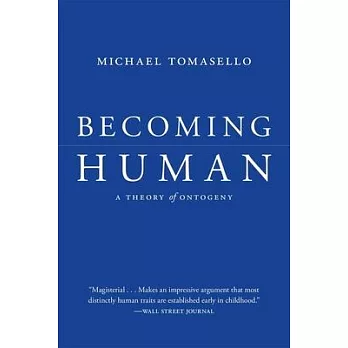
Virtually all theories of how humans have become such a distinctive species focus on evolution. Becoming Human looks instead to development and reveals how those things that make us unique are constructed during the first seven years of a child’s life.
In this groundbreaking work, Michael Tomasello draws from three decades of experimental research with chimpanzees, bonobos, and children to propose a new framework for psychological growth between birth and seven years of age. He identifies eight pathways that differentiate humans from their primate relatives: social cognition, communication, cultural learning, cooperative thinking, collaboration, prosociality, social norms, and moral identity. In each of these, great apes possess rudimentary abilities, but the maturation of humans’ evolved capacities for shared intentionality transform these abilities into uniquely human cognition and sociality.


 借閱次數
:
借閱次數
: 
 點閱:60
點閱:60
 評分:0
評分:0
 評論:0
評論:0
 引用:0
引用:0