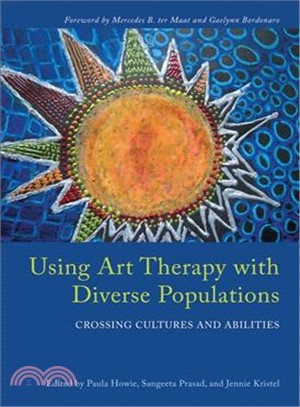
|aUsing art therapy with diverse populations :|bcrossing cultures and abilities /|cedited by Paula Howie, Sangeeta Prasad, and Jennie Kristel ; foreword by Mercedes B. ter Maat and Gaelynn Bordonaro.
260
|aLondon :|bJessica Kingsley Publishers,|cc2013.
300
|a424 p. :|bill. (some col.) ;|c25 cm.
504
|aIncludes bibliographical references and indexes.
505
00
|tPart I. Art therapy and culture --|tch. 1. Exploring outside the box : art therapy in practice /|rJennie Kristel --|tch. 2. Why art therapy works /|rLouis Tinnin and Paula Howie --|tch. 3. Art therapy assessments with diverse populations /|rDonna Betts --|tch. 4. Ethics in art therapy /|rAudrey Di Maria Nankervis --|tch. 5. Walk beside me, not behind me : cultural issues in art therapy supervision /|rLisa Raye Garlock --|tPart II. The culturally sensitive art therapist --|tch. 6. The impact of culture and the setting on the use and choice of materials /|rSangeeta Prasad --|tch. 7. The process of attunement between therapist and client /|rJennie Kristel --|tch. 8. On being human : color and culture /|rPaula Howie --|tch. 9. How spirituality impacts art therapy /|rMimi Farrelly-Hansen --|tch. 10. Practicing multiculturally competent art therapy /|rCheryl Doby-Copeland --|tPart III. The practice of culturally based art therapy in educational settings --|tch. 11. Art therapy in schools : its variety and benefits /|rEmmy Lou Glassman and Sangeeta Prasad --|tch. 12. Working cross-culturally with children at risk /|rAudrey Di Maria Nankervis --|tch. 13. Art therapy as a treatment choice for Autism Spectrum Disorders /|rDeni Brancheau --|tch. 14. Giving teens a visual voice : art therapy in a public school setting with emotionally disabled students /|rEmmy Lou Glassman --|tch. 15. Practice of art therapy in residential schools and group homes /|rCharlotte Boston --|tPart IV. Understanding the cultural implications of using art therapy in hospital and rehabilitation settings --|tch. 16. Warrior culture : art therapy in a military hospital /|rPaula Howie --|tch. 17. Cultural crossroads : considerations in medical art therapy /|rTracy Council and Katharine Phlegar --|tch. 18. Art therapy in Saudi Arabia /|rYasmine J. Awais --|tch. 19. Art-based therapies for substance users and their families : recognition, deliberation, and recovery /|rShanti Ranganathan, Reshma Shanthi Ranganathan, and Reshma Malick --|tPart V. Cultural perspectives : using art therapy in outpatient treatment settings --|tch. 20. Stories without words : a cultural understanding of trauma and abuse /|rLinda Gantt --|tch. 21. Cultural considerations in family art therapy /|rBarbara Sobol and Paula Howie --|tch. 22. The universality of grief and loss /|rHeidi Bardot --|tch. 23. HIV/AIDS : reflecting on 15 years in New York City /|rDaniel Blausey and Yasmine J. Awais --|tch. 24. Cultural considerations of eating disorders through art therapy /|rMichelle L. Dean --|tPart VI. Cultural influences in community-based art therapy --|tch. 25. Art therapy in private practice : what does it take? /|rJennie Kristel and Paula Howie --|tch. 26. The community art studio : creating a space of solidarity and inclusion /|rCatherine Hyland Moon and Valery Shuman --|tch. 27. A self to call home : community-based art therapy and homelessness /|rKate Baasch --|tch. 28. Using a thematic approach to art therapy with seniors : enhancing cognitive abilities and social interactions /|rLinda Levine Madori --|tPart VII. Cultural implications for practicing art therapy with unique populations --|tch. 29. Therapy in the prison subculture : maintaining boundaries while breaking barriers /|rDavid Gusak --|tch. 30. Working with asylum seekers and refugees /|rMarian Liebmann --|tArt as healing with children and adults in Cambodia, China, Ethiopia, and the Ukraine /|rDoris Arrington --|tch. 32. Overseas art therapy journeys /|rFrances E. Anderson --|tch. 33. Developing therapeutic arts programs in Kenya and Tanzania : a collaborative consultation approach /|rCatherine Hyland Moon.
Broadly, this comprehensive book provides an introduction into understanding the influence a particular environment has on the approach one uses for novice as well as for experienced clinicians interested in using art in therapy. Thirty-three chapters are divided into seven parts: art therapy and culture; the culturally-sensitive art therapist; the practice of culturally-based art therapy in education settings; understanding the cultural implications of art therapy in hospital and rehab setting; cultural perspectives; using art therapy in outpatient treatment setting; cultural influences in community-based art therapy; and cultural implications for art therapy in unique populations. The editors and contributors define the history of art therapy, how it works and highlights different diagnostic techniques. They examine the uses of materials, the therapeutic relationship, color and the connection between culture, science, and art, awareness of race and culture issues. They describe working with autistic children, and adolescents, and discuss the medical setting, such as eating disorders, out-patient programs, and dealing with grief and loss. Finally, they tackle the subject of the anti-therapeutic environment prisons--and art therapy, the disadvantaged, and orphans. They target art therapists in the US, and those beginning programs worldwide, interested students, as well as those for whom English is a second language. There are a multitude of black-and-white and colorfigures, and 13 appendixes. Annotation c2013 Book News, Inc., Portland, OR (booknews.com)
Paula Howie, ATR-BC, LPC received her Master's in Art Therapy from George Washington University in 1975. She received her ATR in 1977, became a Board Certified Art Therapist in 1994, a Licensed Professional Counselor (DC, 1997) and in VA (2008). She directed the Art Therapy Service at Walter Reed Army Medical Center from 1979 to 2002. From 1982 to the present, she has been a part time faculty and currently holds the title of Associate Professorial Lecturer in the Art Therapy Graduate Program at George Washington University. Paula has held numerous positions in AATA to include President from 2005-2007. She currently maintains a private practice in Washington, DC, where she focuses on the treatment of trauma; she has authored several art therapy articles, has numerous presentations, and was invited to lecture in South Korea in 2004 and 2006. Since her retirement from Walter Reed, in addition to private practice and teaching, Paula has been actively pursuing her passion for watercolor painting. Sangeeta Prasad, ATR, is an art therapist with experience working in India and the United States of America. She has worked with children and adults with serious mental health problems, and has presented on art therapy in the USA as well as India. Her experience as an art therapist in two very different cultures provides her with the opportunity and expertise to introduce art therapy in India. Through her work, she hopes to bridge the information gap in art therapy between countries that have already established art therapy programs and those in which art therapy is beginning to take root. Jen Kristel has a Masters in Expressive Therapies from Lesley University. For the last 20 years, she has worked in clinical and non-clinical settings using the expressive arts and Playback Theatre, a form of theatre improvisation that uses personal stories of the audience to support community building and healing. Since 2003 she has been working in South Asia (Including India, Bangladesh and Indonesia) teaching Playback Theatre and expressive therapies to local NGOs, Counseling Centres and Universities, working on a wide range of issues. Her hope is to support people in finding their voice and building community.


 借閱次數
:
借閱次數
: 
 點閱:69
點閱:69
 評分:0
評分:0
 評論:0
評論:0
 引用:0
引用:0